
Last Updated on 2 months ago by Michael William
Egyptian Gods: Unlocking the Powerful Secrets of Ancient Divinities
Few civilizations in human history inspire the same sense of mystery, awe, and spiritual curiosity as Ancient Egypt. At the center of its culture lies an extraordinary pantheon of Egyptian Gods—beings of incredible power, symbolic wisdom, and profound stories that shaped one of the world’s oldest civilizations.
Whether you’re fascinated by mythology, planning a trip to Egypt, or simply intrigued by how ancient people understood the universe, exploring Egyptian Gods is like opening a door to a world where divine forces walked alongside humans, guided kings, protected families, and governed the natural world.
In this guide, you’ll uncover the most influential gods, the stories behind them, why they mattered, and how their legacy continues to captivate millions today.
Read more:- Unveiling the Top 10 Most Powerful Egyptian Gods | Ancient Egypt Deities
Why Egyptian Gods Still Matter Today
For thousands of years, Egyptians looked to their gods for protection, justice, fertility, prosperity, and courage. Today, travelers and mythology enthusiasts feel the same pull—seeking meaning, inspiration, and connection to something greater.
Why the fascination continues:
- They represent universal human emotions—love, fear, loyalty, and power.
- Their stories are dramatic, symbolic, and deeply human.
- Their temples and artifacts still stand proudly across Egypt.
- They provide insight into how ancient Egyptians lived and understood the world.
If you’ve ever stood before a massive temple or gazed at a carved deity on a stone wall in Luxor or Aswan, you know the feeling—a mix of wonder, mystery, and excitement.
The Divine Hierarchy: Understanding Egyptian Gods
Egyptian mythology includes more than 2,000 deities, but a few are central to the creation stories, the afterlife, and everyday life.
The Three Major Categories of Egyptian Gods
1. Cosmic and Creation Gods
These gods shaped the universe, the sky, and the cycle of life and death.
Examples: Ra, Atum, Nut, Geb
2. Rulers of the Afterlife
They governed judgment, resurrection, and immortality.
Examples: Osiris, Anubis, Ma’at
3. Protector and Daily-Life Gods
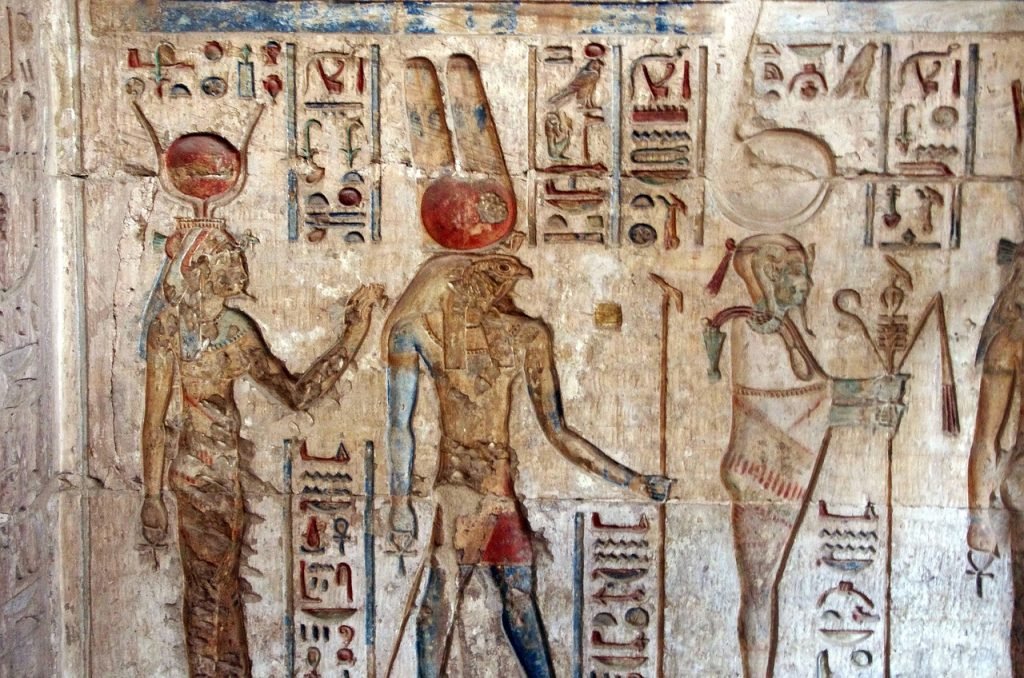
These were the gods that families prayed to for safety, childbirth, wisdom, and fortune.
Examples: Bastet, Hathor, Thoth
Understanding these groups helps you connect each deity to its place in Egyptian life.
Top Egyptian Gods and Their Incredible Stories
Here are the most influential gods whose legends continue to amaze travelers and historians.
Ra – The Powerful Sun God and Creator
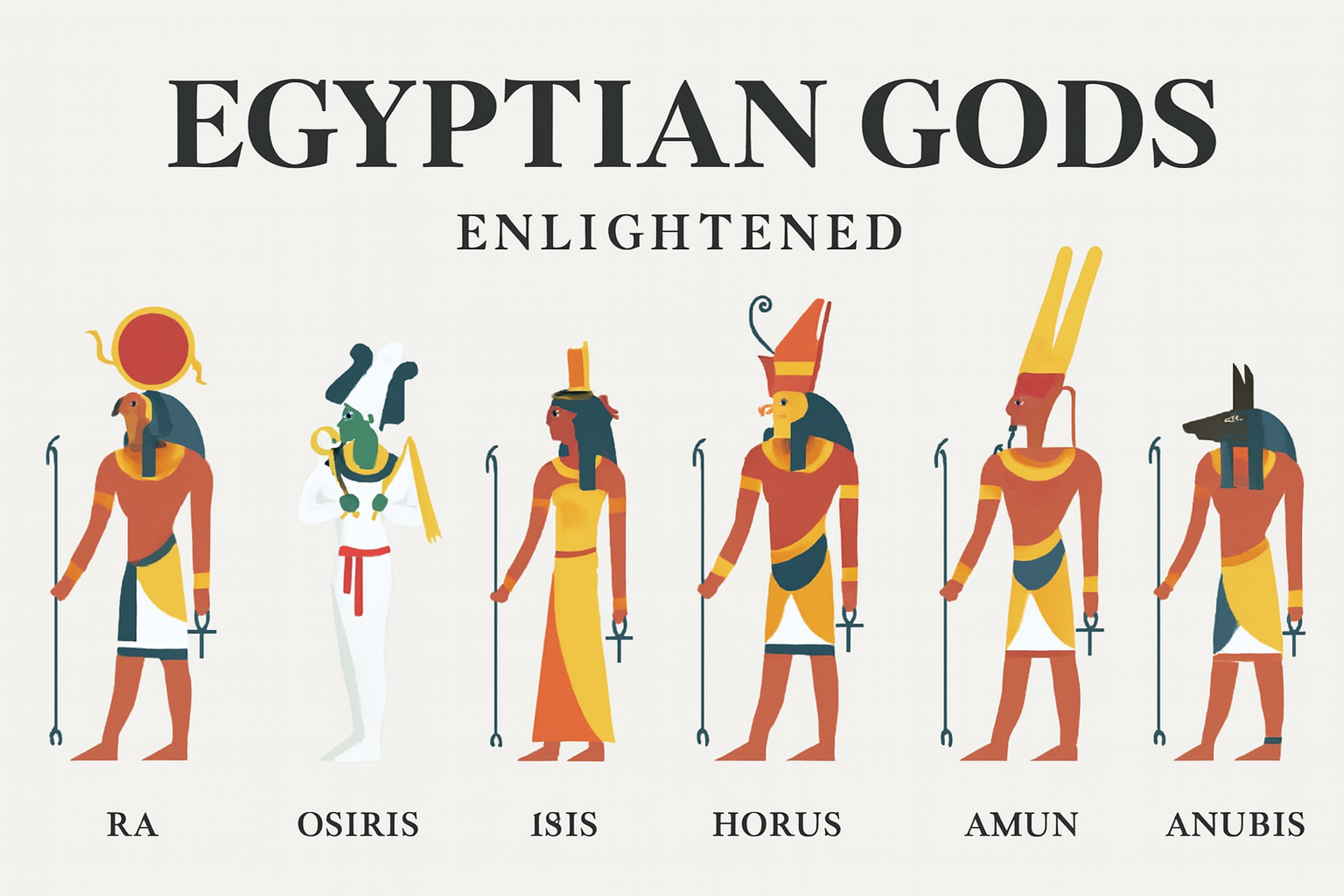
Often depicted with a falcon head crowned by the sun disk, Ra was believed to sail across the sky during the day and journey through the underworld at night.
- Symbol: Sun, light, creation
- Known For: Defeating darkness daily
- Why He Matters: Egyptians believed every sunrise was a sign that Ra had won another battle to protect humanity.
Travelers visiting Karnak Temple can still feel his presence in the magnificent Sun Court.
Osiris – God of the Afterlife and Resurrection
Osiris is one of the most beloved Egyptian Gods, representing rebirth and eternal life.
- Betrayed by his brother Set
- Revived by his wife, Isis
- Became ruler of the underworld
His story is a powerful symbol of hope—showing that life continues beyond death.
Isis – Goddess of Magic and Protection
Isis is the ultimate symbol of loyalty, motherhood, and feminine strength.
- Known For: Her healing spells and protection rituals
- Sacred Animal: Kite bird
- Legacy: Even in modern Egypt, the name Isis appears in ancient temples and papyrus art.

Horus – God of Kingship and the Sky
With the head of a falcon, Horus represents victory, justice, and royal power.
Pharaohs were considered the “Living Horus,” ruling under his divine guidance.
His Epic Story
Horus famously battled Set to avenge his father Osiris—an ancient tale of good versus evil that inspired generations.
Anubis – Guardian of the Dead
Known for his jackal head, Anubis protected tombs, cared for the dead, and performed the weighing of the heart ceremony.
- Symbol: Balance, protection
- Famous Role: Guiding souls to the afterlife
Anubis sculptures are still found in tombs throughout Luxor and the Valley of the Kings.

Ma’at – Goddess of Truth and Justice
Ma’at isn’t just a goddess—she represents the principle of balance that holds the universe together.
- Symbol: Feather
- Importance: Egyptians believed the world would collapse without Ma’at’s order.
Her feather determined whether a soul entered eternal paradise.
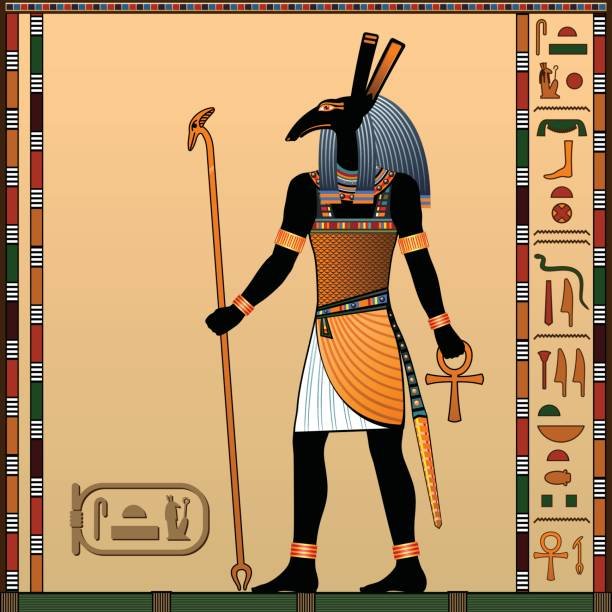
Set – God of Chaos and Storms
A set represents strength but also destruction.
- Known For: Killing Osiris
- Symbol: Desert Storms
- Legacy: Despite his reputation, he was worshipped for protection against enemies.
Thoth – God of Wisdom and Writing
Often shown with an ibis head, Thoth was the inventor of writing and the keeper of divine knowledge.
- Domains: Knowledge, math, magic
- Legacy: Many ancient texts were thought to be “written by Thoth.”
Hathor – Goddess of Joy, Beauty & Music
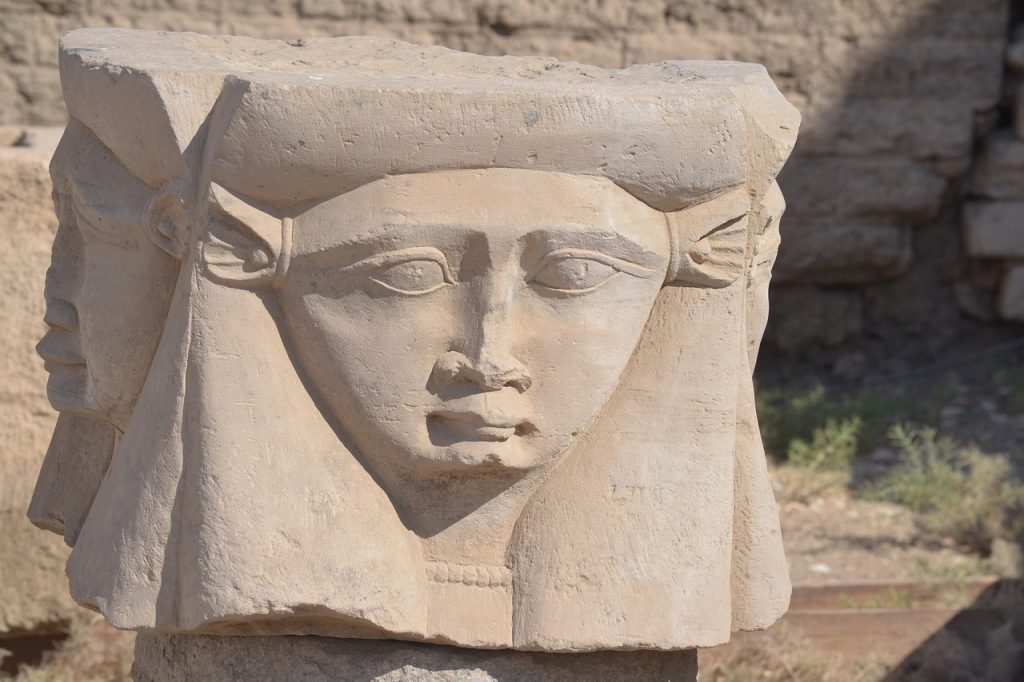
One of the most loved deities, Hathor, brought happiness, fertility, and feminine grace.
Her temple in Dendera is one of Egypt’s best-preserved wonders.
Bastet – Fierce Protector and Cat Goddess
With a cat’s head and a warrior’s spirit, Bastet protected homes and women during childbirth.
Egyptians adored cats because they believed they carried Bastet’s blessing.
How Egyptian Gods Influenced Daily Life
The gods were not distant beings—they were active protectors and guides. Egyptians believed every moment was touched by divine energy.
Daily-life connections:
- Farmers prayed to the Nile gods for a good flood.
- Mothers called upon Isis for fertility.
- Soldiers sought Horus for courage.
- Scribes dedicated their writings to Thoth.
- Pharaohs ruled as embodiments of divine power.
This deep bond explains why temples, rituals, amulets, and festivals filled their lives.
Where to See Egyptian Gods in Egypt Today
If you’re traveling to Egypt, you can see representations of Egyptian Gods across temples, tombs, and monuments.
Top Places to Experience Their Legacy
- Karnak Temple, Luxor – Enclosures dedicated to Amun-Ra
- Luxor Temple – Statues of gods and pharaohs
- Valley of the Kings – Scenes of Anubis and Osiris
- Abu Simbel – Magnificent figures of Ra-Horakhty
- Dendera Temple – Home of Hathor
- Philae Temple, Aswan – Sanctuary of Isis
- Edfu Temple – House of Horus
Each place feels like stepping into a living story.
Traveler Pain Points & How This Guide Helps
Many travelers feel overwhelmed by:
- Too many gods and symbols
- Confusing mythology
- Not knowing which temples to visit
- Wanting a meaningful connection to Egyptian history
This guide simplifies that journey—giving you:
- Clear explanations
- Easy storytelling
- Practical travel insights
- A deeper understanding before you visit
You’ll feel more prepared, more inspired, and more connected when exploring Egypt.
Tips for Exploring Temples Dedicated to Egyptian Gods
1. Visit Early Morning or Sunset
Avoid crowds and enjoy softer light for photography.
2. Bring a Local Guide
They add context, hidden stories, and historical depth.
3. Dress Comfortably
Temples involve walking, stairs, and uneven ground.
4. Respect the Sacred Spaces
Some areas remain spiritually significant today.
5. Take Your Time
Every wall carving tells part of the divine story.
FAQ About Egyptian Gods
Q: Who are the most important Egyptian Gods?
A: The most influential gods include Ra, Osiris, Isis, Horus, Anubis, Set, Hathor, Thoth, and Ma’at. These deities shaped creation, kingship, and the afterlife.
Q: How many Egyptian Gods are there?
A: Historians estimate more than 2,000 Egyptian Gods, including major deities, local gods, and protective spirits.
Q: What roles did Egyptian Gods play in daily life?
A: They governed love, justice, fertility, war, knowledge, and nature. Egyptians prayed to different gods depending on their needs.
Q: What is the difference between Ra and Horus?
A: Ra is the sun god and creator, while Horus is the sky god associated with kingship. In some traditions, they merge into Ra-Horakhty.
Q: Where can I see depictions of Egyptian Gods?
A: You can see them in temples across Luxor, Aswan, Cairo, and Aswan—especially in Karnak, Philae, Abu Simbel, and Dendera.
Q: Which Egyptian God is the most powerful?
A: Ra is often considered the most powerful as the creator and ruler of the cosmos.
Q: Are Egyptian Gods still worshipped today?
A: While not worshipped in the ancient sense, they remain culturally significant and appear in modern art, films, museums, and spiritual symbolism.
Q: Why do Egyptian Gods have animal heads?
A: Animal forms represented qualities like strength (falcon), protection (cat), or knowledge (ibis). It was symbolic, not literal.